
CCTV cameras are undoubtedly one of the best ways to keep your property safe. They allow you to capture the video footage when you are not there and keep it under your surveillance. However, not all CCTV cameras are the same, and the quality of the footage might depend on the lenses attached to these cameras. As you might have guessed, not all CCTV camera lenses are the same. These lenses can be categorized depending on their viewing angles and their capability to adjust focal length. The question here now is – what are the CCTV camera lenses?
Now, in this blog, we will provide information on the types of CCTV camera lenses based on both viewing angles and their focal length adjustment capabilities. So, keeping this in mind, let’s get started!
Types of lenses depending on the view angle

First of all, let’s talk about the types of lenses depending on the viewing angle. In this categorization, the lenses are divided based on their viewing angle. The wider the viewing angle, the more area you can cover with the same camera. But with wider viewing angles, there is a bit of compromise on the footage quality. So, when you go to choose the CCTV camera lens based on its viewing angle, you have to think about both the quality and viewing angle. But before we begin with the categorization lets answer the primary question of what the viewing angle is in the first place.
What is the viewing angle?
The viewing angle is the amount of the scene your CCTV camera is able to view. In other words, it means the width of the view captured by the lens. With a wide viewing angle, you can see more of the surrounding environment but with a bit of compromise in details. At the same time a smaller viewing angle will focus on a smaller portion of the scene but provide you with sharper and more detailed footage.
2.8mm for a 90° view
A 2.8mm lens gives you an ultra-wide angle of view at around 90. What this means is that you will be able to view a large area with only one camera. This type of lens will therefore be ideal for covering really huge open areas like parking lots, warehouses, shopping areas, or basically entrances that require maximum visibility. However because it captures a wider frame, objects farther away may appear smaller in size and with little detail. If you want to track general activities rather than details, then the 2.8mm lens is a good choice.
3.6mm lens for 75° to 90° view
The 3.6mm lens is a balance between width and detail of the footage. It has an angle of view of about 75° to 90°. This is a rather versatile and commonly used lens in CCTV cameras, as it is quite suitable for both indoor and outdoor installations. The focal length provides enough width to cover a spacious room, garden, or office area while still maintaining decent detail to identify movement or people within the frame. It’s a great all-rounder for general surveillance setups.
4mm for a 60° view
With a 4mm lens, the angle of view is rather moderate at about 60° and gives a narrower field of view for close monitoring. This type of lens can be very good when you want to focus on specific areas like building entrances, corridors, or cash counters, where closer and clearer images are needed. It provides a perfect middle ground – not too wide to distort details, yet not too narrow to miss the surrounding activity.
6mm for a 45° telephoto view
The 6mm lens features a 45° telephoto viewing angle that allows you to zoom in on distant subjects to capture more detailed elements that wide-angle lenses cannot provide. It is great for seeing long driveways, perimeter walls, or areas where viewing faces or plates are necessary. Though it covers less of the scene, it excels in situations that require detailed observation over distance and is an ideal choice for targeted security monitoring.
Now, do note that 4mm is the most common type of camera lens, as you get a good balance between viewing angle and quality. Therefore, you get products such as;
- Ratri G11 CCTV Camera
- CCTV Netra V6Z Camera
- Y1-Ratri Dome Indoor Wi-Fi CCTV Camera
- T5P-Ratri Bullet Outdoor Wi-Fi CCTV Camera
- F7-Netra Indoor PT Wi-Fi CCTV Camera
That said, you do also have a high high-quality camera with 3.6 mm viewing angles with products such as CCTV Netra S8 Camera as it is a balance between the sharp quality of a 4mm lens and the wide-angle view from a 2.6 mm lens.
Types of CCTV Camera Lenses Based On their Capability of Adjusting Focal Length
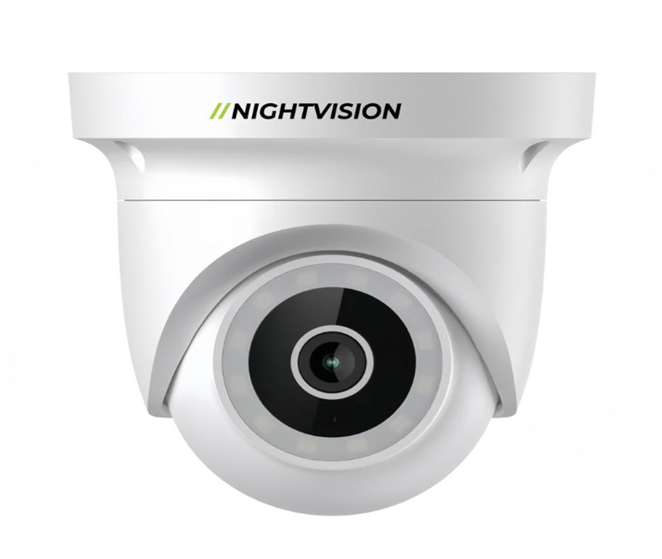
In addition to categorizing CCTV cameras based on their viewing angles, they can also be categorized based on their capability to adjust their focal length. As per this form of categorization, there are six major types. These types include:
Fixed Lens
A fixed lens has a constant focal length, meaning its viewing angle cannot be adjusted. What you see during installation is what you get permanently. These lenses are simple, reliable, and cost-effective, thus best suited to situations where the area of coverage is clearly defined. These include areas such as monitoring entrances, hallways or specific points of interest. Since there are no moving parts to change focus or zoom, the image remains sharply consistent.
Varifocal Lens
With a varifocal lens, you are able to manually set the required focal length and field of view. You can zoom in for a closer, detailed view or zoom out for a wider scene. This makes the varifocal lens very versatile when installed in areas where your monitoring requirements could change over time. They are extremely useful for commercial spaces or outdoor areas where you may want to fine-tune your coverage after installation.
Wide Angle Lens
As the name states, this lens allows the camera to capture more of the scene within one frame. These are perfect for open areas such as parking lots, warehouses, and wide retail spaces. These lenses minimize blind spots and show more area, although they reduce the level of detail for objects that are very far away.
Telephoto Lens
A telephoto lens features an extended focal length that reduces the angle of view, enabling the capture of subjects in more detail from a distance. The camera with this kind of lens is good for monitoring a long driveway, perimeter fencing, or any other location where you need to capture clear images from a distance.It’s often used in specialized security setups, such as traffic monitoring or surveillance of restricted zones.
Manual Zoom Lens
A manual zoom lens lets you physically adjust the zoom level by turning the lens ring. This gives you the ability to fine-tune the image before locking it in place. However, the adjustment must be done on-site, which means you cannot change the zoom level remotely. It’s a rather good option for if you want some control over focal length without the added cost of motorized functionality.
Motorized Lens
A motorized lens allows you to adjust the zoom and focus remotely through the camera’s software or control system. You can easily change the field of view from a wide shot to a close-up without physically handling the camera. These lenses are perfect for high-end surveillance systems where flexibility, precision, and ease of use are necessary.
Now, do note that lenses categorized by focal length and their ability to adjust their focal length are not mutually exclusive and can overlap.
How to Choose a CCTV Camera Lens?
Having the proper lens for your CCTV camera allows the system to work effectively. The lens determines how large an area you are going to be able to see, what detail there will be of the footage, and exactly how well it will fit your specific needs in the case of security. The lens determines how much area you can monitor, how detailed the footage will be, and how well your camera fits your specific security needs. Here are some key points to consider when selecting the right lens:
- Define your coverage area: wide-angle lenses of 2.8mm–3.6mm will work well in open spaces, and longer 4mm–6mm or more lenses for focused monitoring.
- Understand focal length: Shorter lengths encompass wider areas, while longer ones are used to zoom further for more detail.
- Choose: Fixed or varifocal: Fixed lenses are set at one angle, while varifocal or motorised lenses provide variable zoom and focus.
- Consider lighting conditions: Go for IR-compatible or low-light lenses if the area has poor or changing light.
- Match lens type to purpose: Use a wide-angle for general coverage, a telephoto for distant targets, and a motorized lens for remote control.
- Check compatibility: Ensure the lens fits your camera type, mount, and sensor size.
Conclusion
Modern security systems largely feature CCTV surveillance. Before the selection of CCTV cameras, however, one should be aware of the fact that there is a vast range available for cameras in terms of lenses. These lenses, among other functions, affect the quality and field of view, apart from their ability to change their focal length. Therefore, you need to know about various types of CCTV camera lenses.
In this blog, we shared with you various types of CCTV camera lenses, where they are used, and how to select them. Hope that helped you. For further insights into the many aspects of CCTV cameras, do have a look at some of our other blogs. And if you want the best CCTV cameras in Nepal, look no further than Night Vision – the best manufacturer of CCTV cameras in Nepal. Thanks for reading to the end.
Frequently Asked Questions
Which lens is best for home security cameras?
For most homes, a 3.6mm or 4mm lens works best. These lenses offer a good balance of wide coverage and clear detail, making them perfect for monitoring driveways, entrances, and indoor areas.
Can I change the lens of my CCTV camera?
Yes, but it depends on the type of camera. Some cameras have interchangeable mounts, maybe CS or M12 mounts, but generally speaking, with fixed-lens cameras, that is not possible.
What is the difference between varifocal and motorized lenses?
The varifocal lens allows manual zoom and focusing during installation, while the motorized lens enables the adjustment of zoom and focus to be done remotely via camera software or its control system for convenience.
Related Articles
Night Vision
FOR ADVANCED SURVEILLANCE FOR YOUR HOME OR OFFICE
