
Most people buying a CCTV camera in Nepal spend time comparing resolution, night vision, and price. Very few people think about the lens. But the lens is what decides how much of your property the camera actually sees, how far away it can identify a face, and whether that corner of your shop entrance or courtyard gate is captured clearly or cut off entirely.
The lens controls two things simultaneously: the viewing angle (how wide the camera sees) and the focal length (how much detail it captures at distance). According to Wikipedia’s article on focal length, focal length is the optical distance between the lens and the image sensor, and shorter focal lengths produce wider fields of view while longer focal lengths produce narrower but more detailed views of distant subjects. In plain language: a 2.8mm lens sees more of your room, and a 6mm lens sees a person at the end of your driveway in much better detail.
Getting this choice right means your camera actually captures what matters. Getting it wrong means you have a working camera that is watching the wrong area, or watching the right area but not clearly enough to identify anyone in it.
Quick Summary:
- CCTV lenses are categorised by viewing angle (2.8mm to 6mm and beyond) and by focal length adjustment capability (fixed, varifocal, motorised)
- Shorter focal lengths give wider viewing angles but less detail at distance
- Longer focal lengths give narrower angles but much better detail for distant subjects
- The 4mm lens is the most common in Nepal CCTV setups — good balance of coverage and detail
- All NV NightVision cameras use fixed 4mm or 3.6mm lenses matched to their specific use cases
- Available at our products page and the official NV NightVision Daraz store
Types of CCTV Camera Lenses by Viewing Angle

The viewing angle is the width of the scene your camera captures in a single frame. A wider viewing angle covers more of a room or outdoor space but captures less detail on individual subjects, especially at longer distances. A narrower viewing angle covers a smaller area but produces sharper, more identifiable detail on everything within that frame.
Think of it this way: a wide-angle lens is like standing at the back of a room and seeing the whole space. A narrow-angle lens is like looking through a window from across the street — you see far less of the surroundings, but you can read the text on a sign or identify a person’s face with much greater clarity.
According to Wikipedia’s article on lens optics, the relationship between focal length and field of view is inversely proportional — as focal length increases, field of view decreases, and the camera sees a smaller but more magnified portion of the scene. This is why choosing the right focal length for your specific monitoring distance is more important than resolution alone.
2.8mm Lens — Ultra-Wide 90° View
A 2.8mm lens gives you an ultra-wide viewing angle of approximately 90 degrees. This is the widest commonly available focal length in consumer CCTV cameras and suits situations where you need to monitor a large open area from a single camera mount point.
In Nepal home and business setups, the 2.8mm lens works well for wide shop floors in Thamel, open warehouse spaces in Biratnagar, large parking areas, or wide indoor spaces where total scene coverage matters more than identifying detail at distance. The trade-off is that subjects at the far edges of the frame and at distance appear smaller, making identification harder.
3.6mm Lens — Balanced 75° to 90° View
The 3.6mm lens sits between ultra-wide and standard coverage, offering a viewing angle of approximately 75 to 90 degrees depending on the sensor size. It covers a generous area while maintaining better detail than a 2.8mm lens, making it a versatile choice for both indoor and outdoor installations.
The Netra S8 at NPR 3,199 uses a 3.6mm lens, which is why it performs well as a single-room indoor camera in Kathmandu apartments, small offices, and home interiors. The 3.6mm focal length gives it enough width to cover an entire room from a single corner mount while maintaining sharper detail than a 2.8mm lens would provide at the same distance.
4mm Lens — Standard 60° View
The 4mm lens is the most widely used focal length in Nepal’s CCTV market and for good reason. Its approximately 60-degree viewing angle gives you a practical balance of area coverage and subject detail. You get enough width to monitor an entrance, a corridor, a courtyard gate, or a shop counter area clearly, while still capturing identifiable facial detail and physical description at standard indoor and close outdoor distances.
According to Security.org’s security camera guide, the 4mm focal length is consistently recommended for residential and small commercial security setups because it delivers useful identification quality at the distances where most security-relevant events actually happen — typically 3 to 8 metres from the camera mount point.
Four of the five NV NightVision models use 4MP sensors paired with 4mm lenses: the Netra V6Z at NPR 4,999, the Y1-Ratri Dome at NPR 6,499, the T5P-Ratri Bullet at NPR 7,999, and the Ratri G11 at NPR 8,499. The 4mm focal length is the right choice for the majority of Nepal home and business monitoring scenarios.
6mm Lens — Narrow 45° Telephoto View
The 6mm lens takes a narrower 45-degree angle of view and is designed for situations where you need to identify subjects or read details at longer distances. A driveway gate 10 to 15 metres from the camera mount, a perimeter wall along the boundary of a property in Lalitpur, or a road-facing entrance where vehicles approach from further away — these are the situations where a 6mm lens outperforms the 4mm significantly.
According to Britannica’s entry on telephoto lenses, telephoto focal lengths compress the apparent distance between the camera and the subject, producing larger, more detailed images of distant objects than wide-angle configurations at the same sensor resolution. For Nepal outdoor setups where number plate reading or face identification at 10 to 20 metres is a requirement, a 6mm lens delivers meaningfully better results than a standard 4mm.
Viewing Angle Comparison: Which Focal Length Suits Your Nepal Setup?
| Focal Length | Viewing Angle | Identification Distance | Best Nepal Use Case |
|---|---|---|---|
| 2.8mm | ~90 degrees | 3 to 4.5 metres | Wide shop floors, open warehouses, large indoor spaces |
| 3.6mm | ~75 to 90 degrees | 4 to 6 metres | Single rooms, small apartments, home interiors |
| 4mm | ~60 degrees | 5 to 8 metres | Entrances, corridors, courtyards, shop counters, gates |
| 6mm | ~45 degrees | 8 to 15 metres | Long driveways, perimeter walls, road-facing entrances |
| 12mm | ~25 degrees | 14 to 18 metres | Perimeter monitoring, long-distance outdoor identification |
| 50mm | ~5 degrees | 30 to 60 metres | Specialist long-range surveillance |
For most Nepal homeowners in Kathmandu, Pokhara, Chitwan, and Biratnagar, the 4mm lens covers every standard monitoring scenario. For outdoor perimeters and longer-distance identification requirements, a 6mm or 12mm lens provides the detail that a standard 4mm would miss. The CCTV camera range post covers how focal length interacts with night vision range and identification distance in real-world Nepal setups.
Types of CCTV Camera Lenses by Focal Length Adjustment
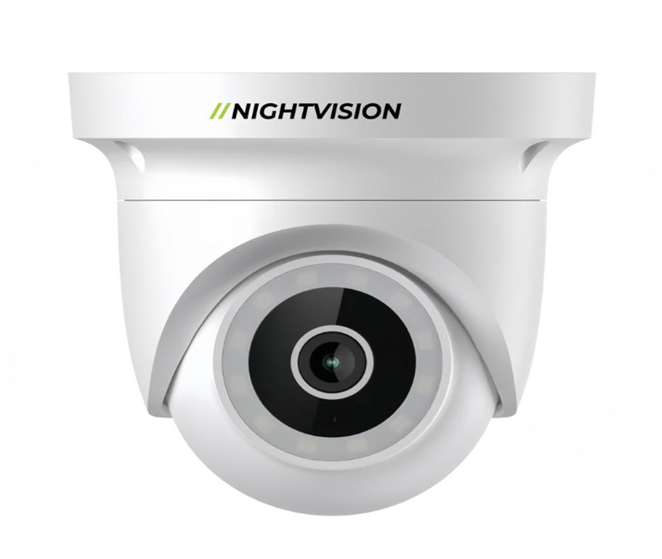
Beyond the fixed focal lengths above, CCTV lenses can also be categorised by whether and how their focal length can be adjusted. This affects installation flexibility, ongoing adjustability, and cost.
Fixed Lens
A fixed lens has a single, unchangeable focal length. Once it is set at the factory and installed, what you see is permanently what you get. Fixed lenses are the most common type in consumer CCTV cameras and are used across the entire NV NightVision range.
The advantages are significant: no moving parts means consistent, reliable image quality day after day. They are simpler, more durable, and cost less than adjustable alternatives. For Nepal homes and small businesses in Bhaktapur, Butwal, Dharan, and Janakpur where the monitoring requirement is clear and fixed, a fixed lens is the practical and cost-effective choice.
Varifocal Lens
A varifocal lens allows you to manually adjust the focal length and field of view during installation. You turn a ring on the lens barrel to zoom in or out and lock the focal length at whatever setting suits your specific installation point. Once locked, it operates like a fixed lens.
Varifocal lenses are useful for commercial setups where the exact monitoring requirement is not known until the camera is physically mounted and you can see what the view looks like. A shop in Pokhara Lakeside with an irregular entrance shape, or an office in New Baneshwor with an unusual corridor layout, might benefit from the ability to fine-tune the angle after mounting rather than committing to a fixed focal length before installation.
Wide-Angle Lens
Wide-angle lenses are a specific category of fixed or varifocal lens optimised for maximum field of view, typically 80 degrees or more. They minimise blind spots in large open areas and are the right choice when total scene coverage is the priority over subject detail.
For large retail floors in Biratnagar, open warehouse spaces in the industrial areas of Hetauda, or wide parking areas in Bharatpur, a wide-angle lens reduces the number of cameras needed to achieve full coverage. The trade-off is reduced detail for subjects at the far edges of the frame.
Telephoto Lens
A telephoto lens uses an extended focal length to narrow the field of view and produce detailed images of subjects at long distances. According to Wikipedia on closed-circuit television, telephoto configurations in CCTV are typically used for perimeter monitoring, traffic surveillance, and access control points where identification at a distance is the primary requirement.
In Nepal, telephoto configurations suit large property perimeters in rural areas of Karnali and Sudurpashchim provinces, road-facing commercial entrances in Dhangadhi and Mahendranagar, and any installation where the camera must identify faces or number plates beyond 15 metres.
Manual Zoom Lens
A manual zoom lens lets you physically adjust the zoom level by turning the lens ring before locking it in position. Like a varifocal lens, adjustment must be done on-site and cannot be changed remotely. The difference between manual zoom and varifocal is primarily mechanical — manual zoom lenses typically offer a wider zoom range but require physical access to the camera for any adjustment.
They provide a middle ground between the simplicity of a fixed lens and the cost of a motorised system, and suit installations where some degree of post-installation adjustment is anticipated but the budget does not extend to motorised remote control.
Motorised Lens
A motorised lens allows zoom and focus adjustment remotely through the camera’s software or control system. You can change the field of view from wide to close-up without touching the camera physically, and adjust it again at any time from anywhere with a connected device.
According to Techopedia’s image sensor definition, motorised lens systems are used in professional PTZ and high-end fixed cameras where operational flexibility and remote management are requirements. The Ratri G11 at NPR 8,499 uses a motorised pan-tilt mechanism that rotates the entire camera rather than adjusting the lens, giving it wider operational flexibility than a standard motorised zoom lens at the same price point for Nepal home and business use.
Lens Type Comparison: Fixed, Varifocal, and Motorised
| Lens Type | Focal Length | Adjustment | Best For | Cost |
|---|---|---|---|---|
| Fixed | Set at manufacture | None — permanent | Clear fixed monitoring points | Lowest |
| Varifocal | Adjustable range | Manual — on-site only | Commercial installs with unclear requirements | Medium |
| Wide-angle | Short (2.8mm to 3.6mm) | Fixed or varifocal | Large open spaces, minimal blind spots | Low to medium |
| Telephoto | Long (6mm and above) | Fixed or varifocal | Long-distance identification | Medium |
| Manual zoom | Adjustable range | Manual — physical access needed | Variable coverage without motorised cost | Medium |
| Motorised | Full range | Remote — via app or software | High-end commercial, PTZ systems | Highest |
How to Choose the Right CCTV Camera Lens for Your Nepal Setup
Choosing the right lens comes down to three questions: how far away is the area you need to monitor, how wide is the space, and do you need the flexibility to adjust after installation?
For single rooms, small apartments, and home interiors in Kathmandu and Lalitpur, a 3.6mm or 4mm fixed lens covers the space from a single corner mount point with good identification detail at 4 to 8 metres. The Netra S8 at NPR 3,199 with its 3.6mm lens and the Netra V6Z at NPR 4,999 with its 4mm lens are the practical choices.
For shop entrances, office lobbies, covered outdoor areas, and apartment building corridors in Pokhara, Butwal, and Biratnagar, a 4mm fixed lens on a dome or bullet camera covers the entry point with the right balance of field width and identification clarity. The Y1-Ratri Dome at NPR 6,499 is the right ceiling-mount option.
For outdoor gates, driveways, and exterior walls where the subject approaches from 8 to 15 metres, a 4mm lens on a bullet camera optimised for outdoor distances gives you clear identification at the range that matters. The T5P-Ratri Bullet at NPR 7,999 is built for exactly this use case.
For large areas, wide properties, or whole-floor coverage from a single mount point, the Ratri G11 at NPR 8,499 uses a 4mm lens combined with 355° motorised pan-tilt rotation, giving you the flexibility to monitor different angles without changing the lens configuration.
Also consider lighting conditions when choosing a lens. For low-light environments, a lens with a wider aperture (lower f-number) allows more light to reach the sensor, improving night-time image quality independently of the IR night vision system. The night vision vs infrared in CCTV post covers how lens aperture and night vision technology interact in NV NightVision cameras.
All five models are available at our products page and on the official NV NightVision Daraz store with COD available on most orders. For confirmed NPR prices across the full range, the CCTV camera price list in Nepal has every model in one place. Visit the team at the NV NightVision head office in Bhaktapur for hands-on lens selection advice before purchasing.
Choosing the Right Lens for Your Nepal Property
The lens decision is simpler than it looks once you know the distance between your camera mount and the area you need to cover. Match the focal length to that distance and your camera will capture exactly what you need.
For most Nepal homes and small businesses, 4mm is the answer. For rooms and small indoor spaces, 3.6mm covers more. For outdoor gates and long driveways, 6mm gives you better identification at distance. The NV NightVision range is built with the right lens matched to each model’s specific use case, so selecting the right camera for your installation point also gets you the right lens automatically.
Browse all NV NightVision cameras to find the right lens configuration for your Nepal setup, or reach the team through the contact page via WhatsApp for advice specific to your property. You can also visit the NV NightVision head office in Bhaktapur for an in-person lens comparison before you decide.
Common Questions About CCTV Camera Lenses
Which CCTV camera lens is best for home use in Nepal?
For most Nepal homes, a 3.6mm or 4mm fixed lens gives the best balance of room coverage and identification detail. The 3.6mm covers a wider area from a single mount, while the 4mm provides slightly sharper identification at 5 to 8 metres. The Netra S8 uses a 3.6mm lens and the Netra V6Z uses a 4mm lens — both are practical home choices from NPR 3,199 and NPR 4,999 respectively.
What is the difference between a fixed lens and a varifocal lens?
A fixed lens has a permanent focal length set at manufacture. It is simpler, more durable, and costs less. A varifocal lens allows manual adjustment of the focal length and field of view during installation, giving you more control over the coverage area. Once locked, a varifocal lens behaves like a fixed lens. Fixed lenses suit clear, defined monitoring points. Varifocal lenses suit commercial installs where requirements may change.
What does focal length mean for a CCTV camera?
Focal length controls two things: how wide the camera sees and how much detail it captures at distance. Shorter focal lengths like 2.8mm or 3.6mm give wider viewing angles covering more area. Longer focal lengths like 6mm or 12mm give narrower angles with much better identification detail at longer distances. Choosing the right focal length for your monitoring distance is more important than resolution alone.
Can I change the lens on my NV NightVision camera?
NV NightVision cameras use integrated fixed lenses matched to each model’s specific use case. The lens is not interchangeable on consumer WiFi cameras like the NV NightVision range. For setups where different focal lengths are needed at different points, the solution is selecting the right model for each installation point rather than swapping lenses on a single camera.
What is a motorised lens and when do I need one?
A motorised lens allows remote zoom and focus adjustment through the camera’s software without physically touching the camera. It is used in professional PTZ systems and high-end fixed cameras where operational flexibility is needed. For most Nepal home and small business setups, a fixed 4mm lens on the right camera covers the monitoring requirement without the added cost of motorised functionality.
Which lens is best for monitoring a long driveway or outdoor gate in Nepal?
For outdoor gates and driveways where a vehicle or person approaches from 8 to 15 metres away, a 4mm lens on a bullet camera optimised for outdoor distances is the practical choice. A 6mm lens gives even better identification detail at longer distances but with a narrower field of view. The T5P-Ratri Bullet at NPR 7,999 is built specifically for this outdoor distance range.
Does the lens type affect night vision performance?
Yes. A lens with a wider aperture allows more light to reach the sensor, improving low-light performance independently of the IR system. Fixed lenses on modern CCTV cameras are typically optimised for both daytime clarity and low-light performance. All NV NightVision cameras use lenses matched to their sensor specifications for the best night vision output at their respective price points.
What viewing angle do I need for a small shop in Nepal?
For a standard small shop in Bhaktapur, Thamel, Pokhara Lakeside, or any other Nepal urban area, a 4mm lens covers the shop floor and entrance from a ceiling or wall mount at 5 to 8 metres with good identification detail. For shops with wider floor plans requiring coverage of a larger area from one camera, a 3.6mm or 2.8mm lens reduces blind spots at the cost of some identification detail at the far edges.